From Wellbeing Strategy to Workforce Infrastructure: How P3 Business Care Helps Organisations Operationalise the 2026 Shift
In 2025, many organisations accepted that workforce wellbeing mattered.
In 2026, the challenge is no longer awareness—it is integration.
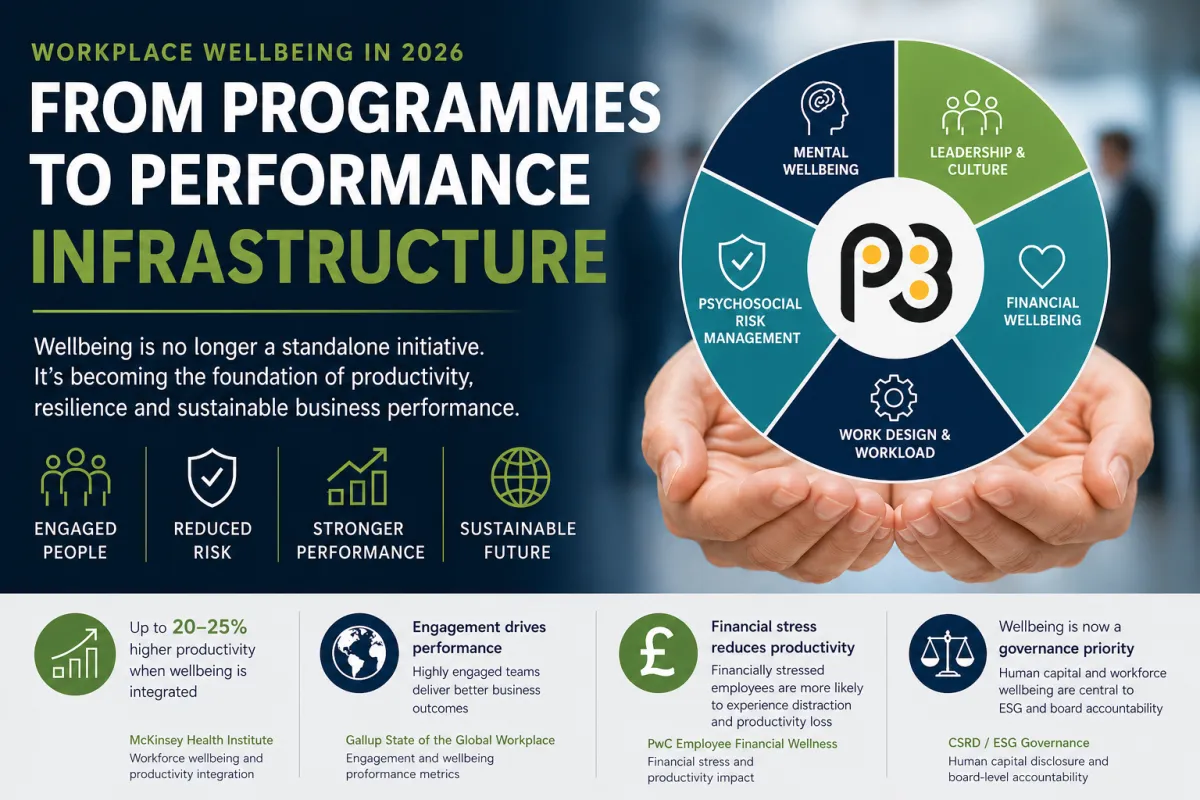
Global research increasingly shows that wellbeing is no longer best treated as a standalone HR initiative, but as a strategic operating system embedded into leadership, governance, productivity, and enterprise resilience.
For many businesses—particularly in manufacturing, offshore energy, logistics, and high-pressure operational sectors—the question is now:
“How do we practically embed wellbeing into the organisation, not just promote it?”
This is where P3 Business Care offers a distinctive strategic advantage.
P3 Business Care: From Wellbeing Programme to Embedded Business Performance Model
P3 Business Care’s Personal. Proactive. Partnership. model is specifically aligned to the growing global shift from reactive employee support to enterprise-wide workforce resilience.
Unlike traditional Employee Assistance Programmes (EAPs), which often rely on employees self-referring after problems escalate, P3 is built around:
Embedded, proactive workforce architecture:
Face-to-face on-site Business Partners
Early intervention before absence or crisis
Psychosocial risk visibility
Leadership support and workforce insight
Mental health, financial strain, and personal challenge support
Workforce trend reporting through Quarterly Management Reports
ISO 45003-aligned psychosocial wellbeing support
In short:
P3 does not simply provide support services.
P3 operationalises wellbeing into daily business practice.
How P3 Aligns With Key 2026 Global Workforce Trends
1. McKinsey Health Institute: Workforce Wellbeing and Productivity Integration
McKinsey’s wellbeing research increasingly highlights that organisations embedding wellbeing into leadership, performance, and organisational systems report stronger productivity and reduced burnout-related cost pressures.
P3 Response:
P3 supports this by integrating:
Leadership:
Business Partner insight into workforce trends
Manager support conversations
Cultural intelligence from frontline operations
Performance:
Reduced absenteeism through earlier support
Better retention through trust-based engagement
Improved presenteeism via visible support structures
Organisational Design:
On-site support integrated into operations
Wellbeing positioned as workforce infrastructure, not occasional initiative
P3 Difference:
McKinsey describes the strategy. P3 provides a practical delivery mechanism.
Digital Reference:
McKinsey Health Institute – Thriving Workplaces
https://www.mckinsey.com
2. Gallup State of the Global Workplace: Engagement and Wellbeing Metrics
Gallup’s 2025/2026 findings show declining global engagement and major productivity losses, while highlighting the critical role of manager engagement and employee thriving. In 2025, global engagement declines were linked to hundreds of billions in lost productivity.
P3 Response:
P3’s model directly addresses Gallup’s key risks:
Engagement:
Regular on-site presence increases trust and connection
Visible support normalises help-seeking
Employees feel seen before disengagement deepens
Manager Capability:
Managers gain practical support when handling workforce pressure
Business Partners act as an early-warning support bridge
Thriving:
P3 supports emotional, relational, financial, and operational wellbeing—not just mental health
P3 Difference:
Gallup identifies the engagement crisis. P3 creates human infrastructure to reduce it.
Digital Reference:
Gallup State of the Global Workplace
3. PwC Employee Financial Wellness: Financial Stress as Productivity Risk
PwC and wider workforce wellbeing research increasingly identify financial stress as a major source of distraction, absenteeism, and cognitive overload. Financial strain is becoming a measurable organisational performance risk.
P3 Response:
P3’s proactive model is particularly effective here because financial pressure often appears before formal crisis:
Salary anxiety
Debt concerns
Family pressure
Cost-of-living stress
Offshore family separation pressures
Through confidential Business Partner relationships, employees often disclose issues earlier—before:
Safety decline
Mental health deterioration
Productivity loss
Workforce attrition
P3 Difference:
Financial wellbeing becomes operationally visible, not hidden until breakdown.
Digital Reference:
4. CSRD / ESG Governance: Human Capital Disclosure and Board Accountability
The CSRD and broader ESG trends are pushing workforce wellbeing into governance and sustainability frameworks, with increasing emphasis on:
Human capital
Workforce resilience
Psychological safety
Social sustainability
P3 Response:
P3 naturally strengthens ESG and governance narratives through:
Data:
Worksite visit reports
Quarterly Management Reports
Trends in psychosocial pressure
Intervention tracking
Governance:
Supports ISO 45003 psychosocial risk frameworks
Demonstrates proactive social responsibility
Strengthens “People” metrics within ESG reporting
Board-Level Relevance:
P3’s reporting model can provide evidence that wellbeing is:
Managed
Measured
Embedded
P3 Difference:
P3 transforms wellbeing from narrative into governance evidence.
Digital Reference:
Why This Matters Most in High-Risk Sectors
For offshore, manufacturing, and energy environments, wellbeing is not simply a retention issue.
It directly affects:
Safety
Focus
Fatigue
Psychological risk
Team cohesion
Incident prevention
In these sectors:
Wellbeing = Operational Risk Management
P3’s proactive, human-centred, face-to-face model is especially powerful because it bridges:
Human wellbeing + Operational performance + Governance accountability
Q&A: Why Organisations Are Increasingly Exploring P3
Q: Is P3 just another wellbeing service?
A:
No. P3 functions more like workforce resilience infrastructure—combining pastoral care, psychosocial visibility, and enterprise risk reduction.
Q: How is P3 different from an EAP?
A:
EAP = reactive, remote, often underused
P3 = proactive, visible, relational, preventative
Q: Can P3 support ISO 45003 ambitions?
A:
Yes—particularly around psychosocial risk awareness, early intervention, leadership insight, and culture support.
Q: Does P3 support ESG / governance?
A:
Yes—through measurable human capital support, reporting, and workforce resilience evidence.
Final Thought: P3 Business Care and the 2026 Workforce Reality
As wellbeing evolves from benefit to enterprise architecture, businesses need more than awareness campaigns.
They need systems.
They need visibility.
They need integration.
P3 Business Care sits precisely in this gap:
Translating global wellbeing strategy into operational reality.
In a world where wellbeing increasingly shapes productivity, governance, resilience, and sustainability…
