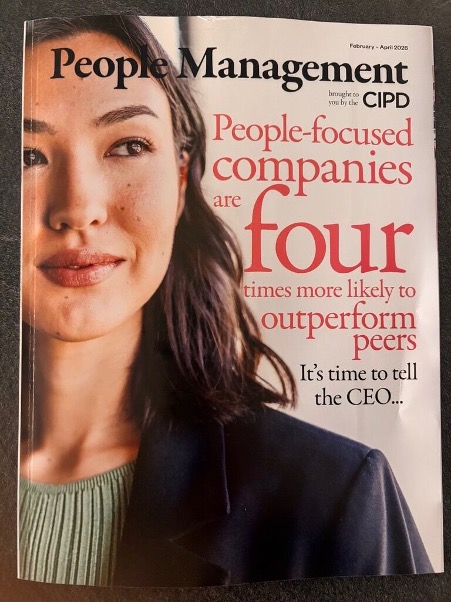
Organisations that genuinely prioritise their people are up to four times more likely to outperform their peers.
A recent feature in People Management highlighted a powerful reality: organisations that genuinely prioritise their people are up to four times more likely to outperform their peers.
This is not sentiment.
It is strategy.
For CEOs navigating cost pressure, regulatory scrutiny, talent shortages and rising psychosocial risk, the evidence is increasingly clear:
People performance drives business performance.
What “People-Focused” Really Means
Being people-focused is not about perks or posters.
Research from Gallup consistently links high engagement with:
Higher productivity
Lower absenteeism
Reduced turnover
Improved profitability
The Chartered Institute of Personnel and Development (CIPD) reinforces that wellbeing must be embedded into business strategy — not bolted on as an HR initiative.
Meanwhile, the Health and Safety Executive (HSE) has made clear that work-related stress is a board-level responsibility.
🔗 HSE Management Standards:
https://www.hse.gov.uk/stress/standards/
🔗 CIPD Good Work Index:
https://www.cipd.org/uk/about/news/good-work-index-2025-investment-line-managers-employee-wellbeing-ai/
🔗 Gallup Workplace Research:
https://www.gallup.com/workplace
The shift is clear:
From reactive support…
To proactive culture design.
Where Many Businesses Struggle
Most organisations still rely primarily on reactive models:
EAP services
Occupational health referrals
Grievance procedures
Crisis intervention
These are necessary — but they activate after damage has begun.
High-performing organisations complement reactive provision with proactive, relational support that identifies pressure early.
This is where P3 Business Care operates.
How P3 Business Care Supports Performance
Founded in 2019 by Jim Grimmer, P3 Business Care was built around a strategic principle:
Personal. Proactive. Partnership.
Rather than waiting for absence, resignation or burnout, P3 embeds structured, face-to-face support within workplaces.
1️⃣ Proactive Presence
P3 Business Partners provide:
Scheduled on-site visits
Informal early conversations
Confidential listening space
Visible wellbeing presence
This creates psychological safety before crisis occurs.
2️⃣ Early Identification of Risk
Through consistent relational contact, P3 identifies:
Emerging stress themes
Job-related pressure points
Leadership blind spots
Cultural friction
Instead of discovering risk through absence spikes, leaders gain early insight.
3️⃣ Data-Led Management Reporting
P3 provides structured reporting including:
Number of worksite visits
Confidential discussions
Job-related issues
Referral patterns
Thematic trends
This gives senior leadership something critical:
Leading indicators — not just lagging data.
4️⃣ Supporting Governance & HSE Alignment
With increasing HSE accountability around psychosocial risk, P3 helps organisations demonstrate:
Proactive intervention
Evidence of duty of care
Stress risk awareness
Preventative action
For boards, this reduces regulatory and reputational exposure.
5️⃣ Reducing Absence & Turnover
From our own ROI modelling within P3, even a 0.5-day reduction in absence per employee can deliver substantial savings.
P3 contributes by:
Supporting employees through life events
Reducing stress escalation
Minimising presenteeism
Strengthening engagement in high-pressure sectors
The financial impact often exceeds investment.
Q&A: The CEO Conversation
Q: Isn’t wellbeing just an HR initiative?
No. Psychosocial risk is now a governance and performance issue.
Q: We already have an EAP - is that enough?
EAPs are reactive. P3 complements them with proactive, visible, relational support.
Q: How do we measure impact?
Track:
Absence rates
Turnover
Engagement
Stress themes
Early intervention data
When combined, these reveal performance trajectory.
Q: What is the first step?
Start with a board-level conversation:
What is our people-risk exposure?
What does unmanaged stress cost us?
Where are we acting too late?
The Strategic Advantage
In finance, we protect capital through governance.
In operations, we protect equipment through preventative maintenance.
But in many businesses, the most valuable asset, your people, is still managed reactively.
If people-focused companies are four times more likely to outperform peers, the issue is no longer theoretical.
It is commercial.
It is cultural.
It is regulatory.
And it is strategic.
The question for CEOs is no longer:
“Can we afford to invest in proactive people care?”
The question is:
“Can we afford not to?”
Ready to reduce people risk and protect performance?
Start the conversation with us today. https://p3businesscare.com/contact-us
