The Hidden Wellbeing Crisis Within the Profession That Supports Everyone Else
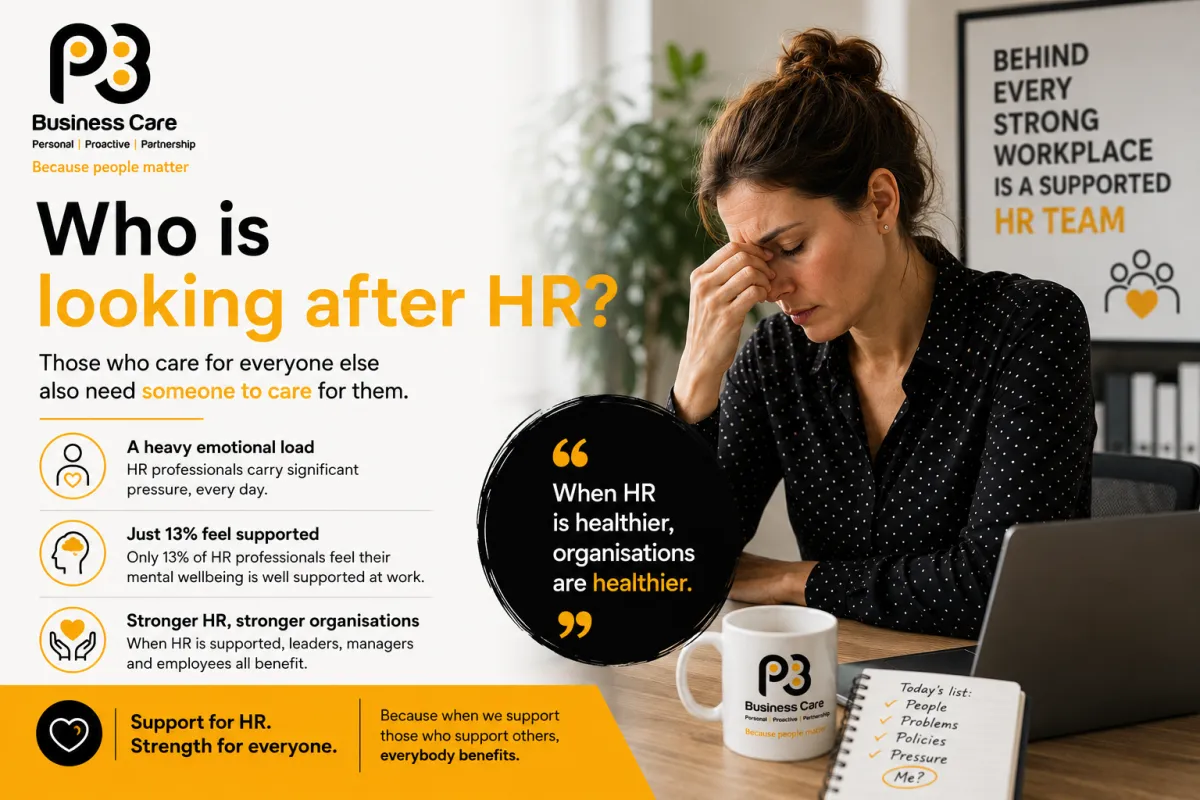
Who Is Looking After HR?
The Hidden Wellbeing Crisis Within the Profession That Supports Everyone Else
June 2026 | Jim Grimmer, Founder, P3 Business Care
HR professionals are often the first people organisations turn to when employees are struggling.
Whether it’s supporting someone through stress, managing conflict, navigating redundancies, responding to mental health concerns, advising leaders during organisational change or simply being available to listen, HR carries a significant emotional load.
Yet one important question is rarely asked:
Who is looking after the people who look after everyone else?
The latest HR Mental Wellbeing Report 2026, published by Ultimate Resilience in partnership with Everywhen, provides a sobering answer.
Only 13% of HR professionals say their own mental wellbeing is well supported at work.
That should concern every CEO, Managing Director and Board.
The Emotional Weight of HR
The report concludes that anxiety, depression and burnout are no longer isolated issues within the profession.
After three years of research, the findings point to a sustained pattern of psychological strain.
HR professionals are increasingly expected to balance:
Employee wellbeing
Organisational performance
Legal compliance
Difficult conversations
Restructuring and change
Employee relations
Safeguarding confidentiality
Supporting managers who themselves may be struggling
All while often carrying their own personal pressures.
Unlike many other professions, HR rarely has a safe place to offload the emotional impact of their work.
They are expected to remain calm, objective and resilient—day after day.
Supporting Everyone Else… But Not Themselves
Ironically, the report also found that many HR professionals do not make full use of the wellbeing support already available within their own organisations.
Why?
There are several possible reasons.
Many feel they should cope.
Some worry about confidentiality.
Others simply don’t have the time.
Some believe they should be the person providing support rather than receiving it.
Whatever the reason, the result is the same:
The people responsible for employee wellbeing are quietly becoming one of the highest-risk groups within the workforce.
This Isn’t Just an HR Issue
When HR struggles, organisations struggle.
An overstretched HR team has less capacity for:
proactive employee engagement
supporting managers
early intervention
culture development
leadership coaching
retaining talent
Instead, valuable time becomes consumed by managing crises that could often have been prevented.
Recent UK research continues to highlight the growing scale of the challenge:
The latest CIPD Health and Wellbeing at Work report found that mental ill health remains the leading cause of long-term sickness absence and that more organisations are recognising wellbeing as a strategic business issue. - https://bit.ly/CIPDReport2025
Health and Safety Executive data shows around 964,000 workers experienced work-related stress, depression or anxiety during 2024/25, accounting for more than 22 million working days lost. - https://bit.ly/MentalHealth-Statistics
Deloitte estimates poor mental health still costs UK employers around £51 billion every year, with presenteeism remaining the biggest contributor. Their research also found that every £1 invested in workplace mental health delivers an average return of £4.70. - https://bit.ly/Deloitte-MentalHealthCosts
These figures remind us that wellbeing is not simply an employee benefit.
It is a business performance issue.
Why P3 Takes a Different Approach
At P3 Business Care, we have always believed that support works best before people reach crisis.
Our Personal • Proactive • Partnership model is built around consistent face-to-face relationships.
That includes HR teams.
Rather than waiting for someone to ask for help, we spend time within organisations building trusted relationships where conversations happen naturally.
For HR professionals, that means having someone independent who understands the pressures of their role, offers confidential support and provides an opportunity to reflect before pressure becomes burnout.
We are not there to replace HR.
We are there to support HR.
When HR is healthier, leaders are better supported.
Managers become more confident.
Employees receive earlier intervention.
The whole organisation benefits.
Looking After Those Who Look After Others
As organisations continue investing in employee wellbeing, perhaps the next question leaders should ask is this:
“What are we doing to support our HR team?”
Because if we expect HR professionals to care for everyone else, we must also ensure someone is caring for them.
At P3 Business Care, that’s exactly where we believe proactive support can make the greatest difference.
Connect With P3 Business Care
If your HR team is carrying increasing emotional pressure, supporting complex employee issues, or simply needs an independent partner alongside them, we’d welcome the opportunity to talk.
P3 Business Care provides proactive, relationship-based support that complements your existing HR function—helping organisations strengthen wellbeing, reduce escalation, support managers and protect organisational performance.
Because when we support the people who support everyone else, everybody benefits.
Visit www.p3businesscare.com to learn more or contact us to arrange an informal conversation.
Further Reading
